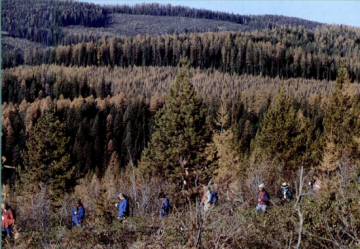
The 4,900-acre Miller Creek Demonstration Forest was set aside for research by the Flathead National Forest in 1989. However, experimental prescribed fire and silviculture treatments to encourage western larch (Larix occidentalis) regeneration began in 1966.
Ecology
The Miller Creek Demonstration Forest is dominated by forests that thrive in cool, moist habitats. Western larch, Douglas-fir (Pseudotsuga menzeisii), subalpine fir (Abies lasiocarpa), Engelmann spruce (Picea engelmanii), lodgepole pine (Pinus contorta), and a smaller proportion of western white pine (Pinus monticola) can all be found together regardless of elevation or aspect.
Documents
- Prescribed fire and wildfire in clearcut mixed-conifer forests on Miller Creek and Newman Ridge, Montana
- Experimental forests and climate change: views of long-term employees on ecological change and the role of Experimental Forests and Ranges in understanding and adapting to climate change
- Miller Creek: ecosystem recovery in a western Montana forest 30 years after prescribed burning and wildfire
- Miller Creek Demonstration Forest - A forest born of fire: a field guide
- Natural revegetation of burned and unburned clearcuts in western larch forests of northwest Montana
- Clearcutting and fire in the larch/Douglas-fir forests of western Montana: a multifaceted research summary
- Database for post-fire succession, first 6 to 9 years, in Montana larch-fir forests
- Broadcast burning in larch-fir clearcuts: the Miller Creek-Newman Ridge study
- Seedbed characteristics in western larch forests after prescribed burning
- Smoke column height related to fire intensity