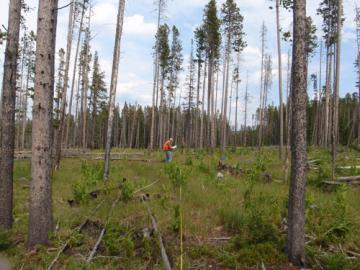
The Tenderfoot Creek Experimental Forest (TCEF) was established in 1961. Elevation of the TCEF ranges from about 6,000 to 8,000 feet, and freezing temperatures are possible in any month of the year.
Ecology
TCEF is dominated by lodgepole pine (Pinus contorta var. latifolia) forest types. The most common habitat type found on the Experimental Forest is subalpine fir/grouse whortleberry (Abies lasiocarpa/Vaccinium scoparium). The subalpine forests of the TCEF are mixed-age stands that reflect the area's fire history.
Documents
- Forest fuels and potential fire behaviour 12 years after variable-retention harvest in lodgepole pine
- Experimental forests and climate change: views of long-term employees on ecological change and the role of Experimental Forests and Ranges in understanding and adapting to climate change
- Roads impact the distribution of noxious weeds more than restoration treatments in a lodgepole pine forest in Montana, U.S.A.
- Management guide to ecosystem restoration treatments: two-aged lodgepole pine forests of central Montana, USA
- Surface fuel litterfall and decomposition in the Northern Rocky Mountains, U.S.A.
- Using bark char codes to predict post-fire cambium mortality
- Snow accumulation in thinned lodgepole pine stands, Montana, USA
- Two-aged silvicultural treatments in lodgepole pine stands can be economically viable
- Estimating canopy fuel characteristics in five conifer stands in the western United States using tree and stand measurements
- The use of silviculture and prescribed fire to manage stand structure and fuel profiles in a multi-aged lodgepole pine forest
- Estimating forest canopy bulk density using six indirect methods
- Stereo photo guide for estimating canopy fuel characteristics in conifer stands
- Effect of alternative silvicultural treatments on snow accumulation in lodgepole pine stands, Montana, U.S.A.
- Analysis of algorithms for predicting canopy fuel
- Role of fire in determining annual water yield in mountain watersheds
- Using airborne laser altimetry to determine fuel models for estimating fire behavior
- Research on stand management options for reducing fuels and restoring two-aged lodgepole pine communities on the Tenderfoot Creek Experimental Forest
- Stem mortality in surface fires. Part II: experimental methods for characterizing the thermal response of tree stems to heating by fires
- Assessment of the line transect method: an examination of the spatial patterns of down and standing dead wood
- Flumes, historic water yield and climatological data for Tenderfoot Creek Experimental Forest, Montana
- Environmental assessment: Tenderfoot Creek Experimental Forest - Vegetative treatment research project, Kings Hill Ranger District, Lewis and Clark National Forest, Meagher County, Montana
- Modeling effects of prescribed fire on wildlife habitat: stand structure, snag recruitment and coarse woody debris
- Appendix A - Biological assessment, TCEF research project for Lewis and Clark National Forest
- Restoring fire in lodgepole pine forests of the Intermountain West
- Historic role of fire in determining annual water yield from Tenderfoot Creek Experimental Forest, Montana
- Methods for the quantification of coarse woody debris and an examination of its spatial patterning: a study from the Tenderfoot Creek Experimental Forest, MT
- Fire history of Tenderfoot Creek Experimental Forest Lewis and Clark National Forest