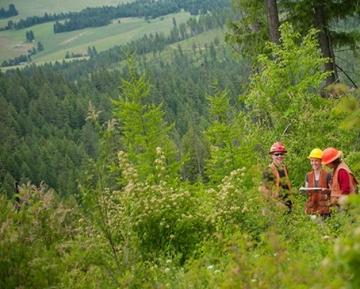
For more than 80 years, the University of Idaho Experimental Forest (UIEF) has provided a working forest classroom for students. The management units, natural areas, and outdoor classrooms provide the connection to field-based forestry education and faculty and graduate research. In 1932, the Forest Development Company (now Potlatch Corporation) of Lewiston, Idaho, made the first of several land donations that would eventually total over 6,500 acres. Other donations, exchanges, and purchases have brought the acreage to its present 7,300 acres split between multiple units.
Although the elevation range across the units is around 305m (1,000 feet), the potential climax communities are varied and transition from true prairie only a few miles away to subalpine fir (Abies lasiocarpa) within the UIEF. Grand fir (Abies grandis) is the dominant tree species followed by Douglas-fir (Pseudotsuga menziesii), western hemlock (Thuja plicata), subalpine fir, and ponderosa pine (Pinus ponderosa) (Schmidt & Friede 1996). Some of the dominant understory species in the UIEF include mallow ninebark (Physocarpus malvaceus (Greene) Kuntze), common snowberry (Symphoricarpos albus (L.) S.F. Blake), roses (Rosa L spp.), ocean spray (Holodiscus discolor (Pursh) Maxim.), Idaho fescue (Festuca idahoensis Elmer), Columbia brome (Bromus vulgaris (Hook.) Shear), pinegrass (Calamagrostis rubescens Buckley), bluebunch wheatgrass (Pseudoroegneria spicata (Pursh) A. Love), yellow avalanche lily (Erythronium grandiflorum Pursh), and strawberry (Fragaria L. spp.) (Sherman et al. 2018).
The average winter temperature is 0 °C (32 °F), average daily minimum -4 °C (25 °F), while the summer average temperature is 17 °C (63 °F) with an average daily maximum of 27 °C (80 °F). The majority of the yearly precipitation (annual average 59.5 to 74 cm [23.4 to 29.1 inches]) falls during the winter months, with an average annual snowfall of 122 cm (48 inches). Soils are very deep to deep at 1.5 m (60 inches), well drained to moderately well drained and formed in volcanic ash, in loess, and in granitic residuum (Schmidt & Friede 1996).
The UIEF has a long history of various uses and disturbances, including grazing, recreational uses, commercial logging, and fire.
Citations:
Schmidt, W.C., and Friede, J.L. (1996) Experimental Forests, Ranges, and Watersheds in the Northern Rocky Mountains: A Compendium of Outdoor Laboratories in Utah, Idaho, and Montana. USDA Forest Service Intermountain Research Station, General Technical Report INT-GTR-334, 128 p. https://www.fs.usda.gov/rm/pubs_int/int_gtr334.pdf
Sherman, L.A., Page-Dumroese, D.S. and Coleman, M.D. (2018) Idaho forest growth response to post-thinning energy biomass removal and complementary soil amendments. GCB Bioenergy, 10: 246-261. https://doi.org/10.1111/gcbb.12486
Documents
- Integrating active fire behavior observations and multitemporal airborne laser scanning data to quantify fire impacts on tree growth: A pilot study in mature Pinus ponderosa stands
- Fire and land cover change in the Palouse Prairie–forest ecotone, Washington and Idaho, USA
- Pyroaerobiology: the aerosolization and transport of viable microbial life by wildland fire
- Fire behaviour in masticated forest fuels: lab and prescribed fire experiments
- Physical and chemical characteristics of surface fuels in masticated mixed-conifer stands of the U.S. Rocky Mountains
- Fire behavior and ecological effects of burning masticated forest fuels
- Masticated Fuels and Fire Behavior in Forests of the Interior West
- Effect of particle aging on chemical characteristics, smoldering, and fire behavior in mixed-conifer masticated fuel
- Impacts of fire radiative flux on mature Pinus ponderosa growth and vulnerability to secondary mortality agents
- The relationship of post-fire white ash cover to surface fuel consumption
- Experimental forests and climate change: views of long-term employees on ecological change and the role of Experimental Forests and Ranges in understanding and adapting to climate change
- Regression modeling and mapping of coniferous forest basal area and tree density from discrete-return lidar and multispectral satellite data
- Characterizing and mapping forest fire fuels using ASTER imagery and gradient modeling
- Germination and initial growth of four coniferous species on varied duff depths in northern Idaho
- Effects of slash pile burning on the physical and chemical soil properties of Vassar soils
- Mortality of western larch seedlings in relation to seedbed characteristics at the dry end of its ecological range
- Livestock grazing influences on community structure, fire intensity, and fire frequency within the Douglas-fir/ninebark habitat type